
News
Inside Foodbank: Australia's Largest Food Relief Agency
Part two of three. A different model in every state, and what a handling fee is actually for
21 October 2026
Part two of three
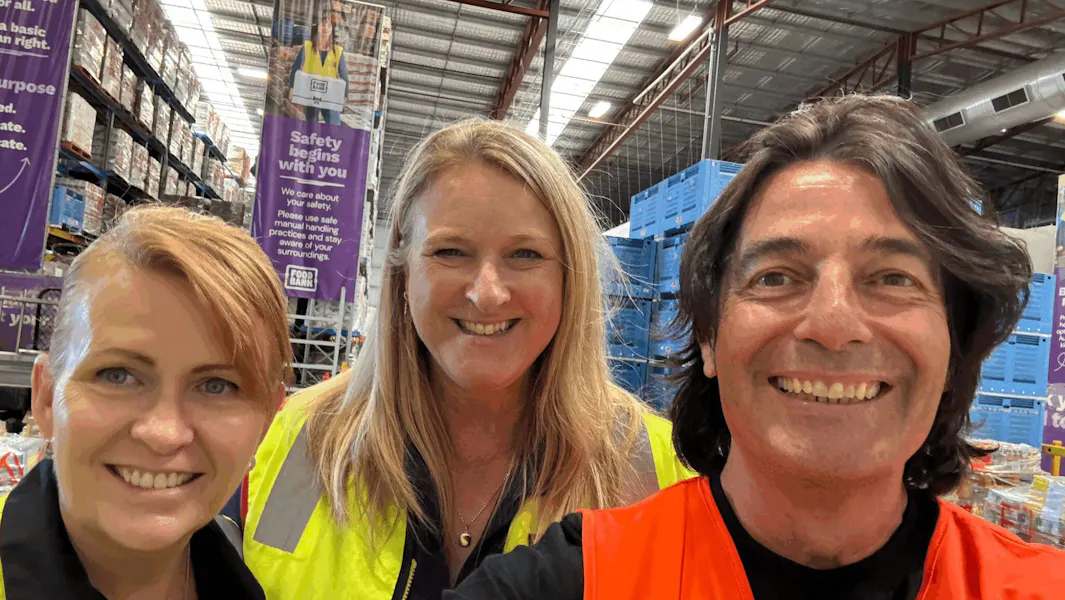
In January we visited SecondBite, who collect surplus food and move it in bulk to the relief agencies that hand it out. In February we went to Foodbank's WA head office near Perth Airport and met Kate O'Hara, the WA CEO, and Kylea Tink, the National CEO.
Everything below is what Foodbank told us at the time of that visit. Charities move quickly and figures change, so treat them as a February 2026 snapshot rather than today's numbers.
The biggest, and a different shape in every state
Foodbank is Australia's largest food relief agency, and unusually it works both directly with the people who need food and with charity partners. At the time of our visit it was providing over 60 per cent of all the food and groceries used across the Australian not-for-profit sector.
It operates in every state and territory, and the shape of the operation is tailored to each community rather than copied from a template:
- In WA, six branches and 46 mobile locations around them, where people choose and purchase the products they want for their families.
- In SA and the NT, what Foodbank calls Food Hubs.
- In NSW, a model focused almost entirely on supplying food and groceries to the not-for-profits rather than to households.
Across all of it, the organisation was supporting nearly 3,000 charities a year and another 3,500 schools.
What a Foodbank branch is actually like
It isn't a Coles, a Woolworths or an Aldi, and it doesn't pretend to be. What it has is enough to keep a family fed, healthy and clean.
Where households shop directly, Foodbank may charge a handling fee based on weight. A 700g box of a popular breakfast cereal, or washing detergent, might be charged at $1.50 a kilo, so about $1.25. Milk and bread might be 50 cents a kilo. Fruit and vegetables are free, with a volume cap so more people can be served.
The point worth understanding is what that fee is for. It doesn't pay for the food, which is donated. It covers the logistics of sourcing and distribution, keeps the service sustainable, and supports the habit of budgeting and planning that most people using it want to hold onto.
A referral is usually needed where shopping direct is available. Foodbank's own site has the details, and it operates in every state as well as internationally through the Global Foodbanking Network.
Where the food comes from
The donor list runs from the big retailers through to hundreds of growers and manufacturers. Coles, Woolworths and Aldi are all there, alongside names like SPC Global, Simplot, McCain Foods, Nestlé and Mars.
That mix is what lets Foodbank supply staples rather than only surplus. A food rescue model takes whatever happens to be spare that day. A bulk supply model can go looking for the flour, the pasta and the long-life milk that a household actually needs.
What this has to do with a surplus food app
Foody Bag sells surplus cheaply to people who'll pay a few dollars for it. Foodbank gets food to people whose problem is cashflow, at a handling fee or no charge at all. Different jobs, and the gap between them is the point.
What stayed with us from the Perth visit was how deliberately the model bends to each state. There's no single right way to run food relief, only the version that fits the community in front of you.
Next in the series
OzHarvest completes the trio, and runs differently again: yellow vans, no warehouse in the middle, straight from donor to charity.
Our thanks to Kate and Kylea for the time.


Foody Bag's mission is to reduce food waste.
Made in Australia with love
Copyright 2026 - All rights reserved