
News
Inside SecondBite: How Australia's Food Rescue Actually Works
The first of three visits to Australia's big food relief organisations, starting in a new warehouse in Kewdale
21 October 2026

Three names, and most people can't tell them apart
SecondBite, Foodbank and OzHarvest are the three big names in Australian food relief. Ask someone what the difference is and you'll usually get a shrug.
We call them the Food Relief Triangle, and we set out to visit all three and report back. They're doing different jobs with the same intent, and the differences turn out to matter. This is the first of the three.
A bigger shed is not a small thing
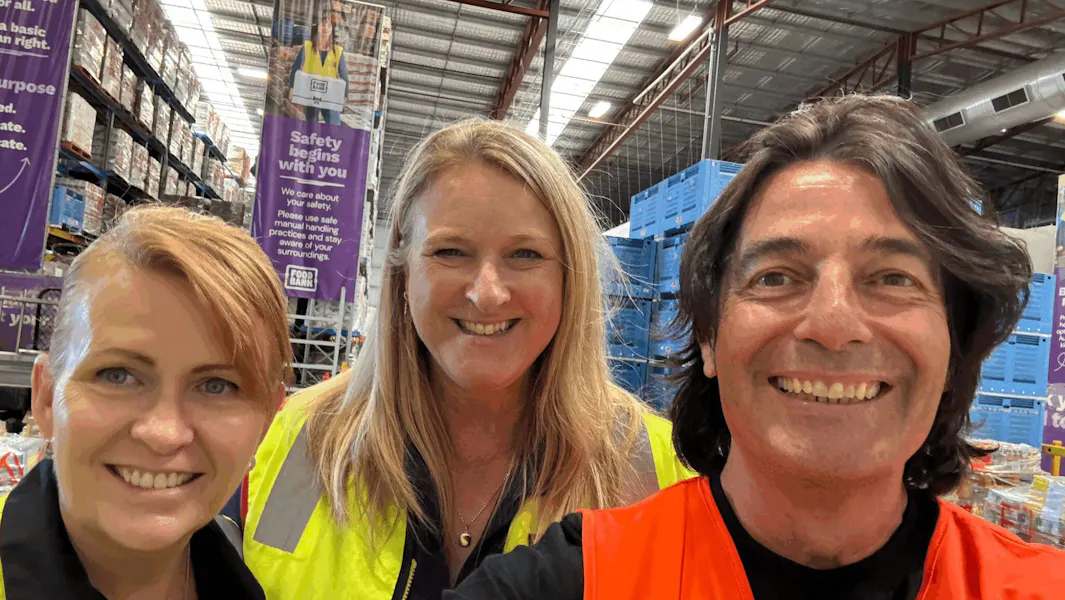
We visited in January 2026. SecondBite's WA operation had moved to a new facility in Kewdale, a serious step up from the old Belmont site, and we were shown around by Lyndon Nilsson, SecondBite's WA State Manager, who has been with the organisation for over a decade.
A bigger building sounds unremarkable until you think about what food relief actually needs:
- Capacity to take in far more food at once.
- Proper cold-storage infrastructure, which is what decides whether fresh produce can be accepted at all.
- Enough reach to serve communities right across WA rather than a few suburbs.
Cold storage is the quiet one on that list. Without it you can only take food that keeps, which rules out most of what a supermarket or a produce market has spare.
How the SecondBite model works
SecondBite collects surplus food, largely with its own fleet, from major donors including supermarkets and fresh produce markets. That food is sorted and repacked at a facility like Kewdale, then distributed to local relief agencies who know their own communities far better than any central organisation could.
So SecondBite is a middle layer rather than a front door. It very rarely hands food to an individual. It moves food in bulk to the organisations that do.
And it gives all of it away. No charge to the agencies, no charge to the people who end up eating it.
The obvious question: how is any of this free?
That was what we most wanted to ask. If you run a fleet of refrigerated trucks and a warehouse full of cold storage, somebody is paying for it.
The answer is that the two halves are funded separately. The food is donated rather than bought, so it costs nothing to acquire. The operation around it, the trucks, the fuel, the staff, the refrigeration, is paid for by a mix of corporate partners, grants, trusts and foundations, and individual donors.
Coles has been the largest of those partners since 2011, contributing both food and money. SecondBite's own figures put the Coles contribution for FY25 at the equivalent of 37.9 million meals, with Coles appeals raising more than $3.1 million on top.
Grants do the heavy lifting on infrastructure. The Perth warehouse fit-out was supported by a Lotterywest grant, which is a reminder that a new shed in Kewdale is not something a charity simply decides to buy.
SecondBite now works with almost 1,100 charity partners and more than 1,500 food donors nationally. Those are its own published numbers.
Why a surplus food app went to visit
Foody Bag sells surplus food cheaply to people who'll pay a few dollars for it. SecondBite moves surplus food, free, to people who can't pay at all. Those are different jobs and neither replaces the other.
What struck us at Kewdale is how much of the problem is logistics rather than goodwill. There's no shortage of businesses willing to give food away. The hard part is having a truck in the right place, with the right refrigeration, at the right hour. That's true for a bakery with six loaves left and it's true at the scale SecondBite works at.
Next in the series
Foodbank and OzHarvest are next, and both run differently again. One is the bulk supplier behind much of the sector and also runs branches where households shop directly. The other rescues and delivers straight to charities with no warehouse in between.
Our thanks to Lyndon for the time and the tour.


Foody Bag's mission is to reduce food waste.
Made in Australia with love
Copyright 2026 - All rights reserved